
Hora
cine n-a văzut Ciuleandra nu-şi poate închipui ce înseamnă beţia dansului / whoever has not seen the Ciuleandra cannot imagine what the intoxication of the dance means. Liviu Rebreanu, Ciuleandra

So, I tell her, I find process work hard because I have to unlearn much of what I am good at as an anthropologist. Tell me more, she says. To feel my way into another person I was trained to empty myself, to listen until I understood them from the inside, and then to set a part of myself above the two of us, at the right distance, so that I stayed neutral and objective. A good social science instrument. She looks at me. But how can you be present with someone if you’re doing all that? Presence is staying yourself and attuning to the other, sensing them, seeing that you’re already entangled, and working from there to find what’s possible.
So at my next coaching session, with me as the coach, I try it. Let it be a dance, I tell myself. Sense, say something, watch how she moves. Work from what’s between us, not from what my head reports. I can’t, dear reader. She starts talking and something in me locks on. She’s grieving the job before she’s lost it. She can’t see the doors still open. Her old fear of not being good enough is up, she’s someone who has never let herself fail so she can’t say the word lost. And on it builds, the reads assembling, steering my questions before I choose them, the level ground between us tilting, until we aren’t two people in a room anymore, but only the reader and the read.
Nothing I read was wrong, and every true thing I saw lifted me another inch above her, and by the end I was with my picture of her, not with her. The mind doesn’t fail at seeing the person, it succeeds, and the success is the failure. I kept trying to think my way out of the thinking, and it never occurred to me that this was the trap. The one who’d put the instrument down is the instrument. Ask the mind to stop standing over the encounter and it just stands there more carefully, adds be present to the list of things to perform. I was on a fool’s errand, reaching for presence by the one road that guarantees you never arrive.
So I got angry at myself. You are such a fraud, Corina. You believe in entanglement, you quote Ingold all the time. Your grandparents raised you on it, you nearly left this whole anthropology field over its extraction, its way of turning people into data, and you hate being the expert in the room because the moment you are, everyone turns to you and hands over their own knowing. So why, when you believe all of it in your mind, can you not let the damn expert go for one hour in an actual room?
And I can hear you too, dear reader. Why is this such a crisis, Corina, what’s so wrong with a good expert who helps a person think?
Here’s what’s wrong. Being with her, fully, undefended, felt like it would take me somewhere I couldn’t stay whole, so the mind grabbed the map the way a hand grabs a rail. That’s what the analysis is, not knowledge, a rail. And I understood, sitting there, what I was so afraid of falling into: her, the room, the between of us, the entanglement, losing the one clean separate self I was raised to believe I am, and not coming back.
But that self is the fantasy. That is the part my conditioned brain has exactly backwards. The bounded, self-contained individual, sovereign and entire, that is the story, laid down by centuries of Western schooling that told me I am a thing that ends at my skin. And it was laid, uncomfortably, over something older my Romanian grandparents had already put in me, that we are enmeshed, that a person is a knot in a net of others and nowhere without them. Two conditionings that do not agree, and for years the newer one won, because my discipline armed it. Objectivity, rigour, the empty vessel. It took the loudest of the two voices and dressed it as a method, so that I couldn’t hear it as conditioning at all, only as competence.
And this is the fool’s turn, because entanglement is not a danger to reality. Entanglement is reality, the actual way the world is put together. So when I chose the map, when I stood above her to stay safe and whole, I did not choose the more rigorous path. I chose a fantasy, a clean separable world that isn’t there, and then I called what I produced in it knowledge. Real knowledge, I was sure, the kind you can only get from the proper distance. It was the opposite: confident, methodical, well-trained knowledge about a world that does not exist. And the true thing, the living thing, was in the place my conditioning told me was too soft to hold anything real: in the entanglement itself, in the person unfolding right there in the meeting with me.
Because she was not a finished object waiting to be read, none of us are. This is the thing Ingold kept saying that I could recite and could not do, that we do not meet as two closed things and transact. We form in the meeting, going along in the same current, becoming ourselves through the reaching. She was becoming, right there, with me, in the space I kept climbing out of to get a better look. My forensic read froze her into something fixed so I could be objective about it, and in doing so it erased the one thing that was actually real: that she was making herself in relation to me, and I was part of what she was becoming. The expert who reads the other erases the other’s hand in the reading. My method of care was extractive after all, and the very thing I left the field to escape, I was doing in the name of help.
I thought about Ingold then, a little unkindly, the unkindness you're allowed only with the writers you love most. He writes so beautifully about it. But could he do it, sit in the entanglement itself, sense his way through it, with no page to write it on afterward? The mind reaches, and the reaching is not nothing. But it’s in the practice that knowledge finally gets tested against the real. And by that test I was failing.
So if the mind could not teach me this, something else would have to.
Emptied, and filled
I am sitting on the floor, cross-legged, facing a man I have never met. Our teacher explains the practice. For those of you who’ve sat Vipassana, he says, this will feel familiar, Insight Dialogue is the same mindfulness, brought into relationship. Meditating together, out loud. He gives us the guidelines and tells us not to memorise them, just to let them work on us: pause, relax, open, trust emergence, listen deeply, speak the truth. When the bell rings, one of you speaks whatever is actually present, not a story you prepared, but what is arising as you sit here. The other only listens. Not planning a reply, not fixing anything. Then we pause in silence, let it settle, notice what it stirred in the body. When the bell rings again, you trade. You don’t have to know where it’s going.
I am uncomfortable. Will I do a good job. It feels exposing, and a bit indecent, to not speak and just sense a stranger. Well. I’ll give it a go.
I go first, it feels less exposing somehow. I speak about feeling alone inside myself, how hard it is to love myself even with so many good people around me, the loneliness I feel right now, while he listens, that even here, being received, it still feels like I am speaking into a void. I am not trying to make sense to myself, and that is oddly freeing. I chuckle and tell him about the orange street cat I see near my house, who greets me with a confident yowl every time she spots me coming. So sure of herself, so scruffy. The neighbours keep trying to catch her, find her owner, get her to a shelter, and every time she slips them and comes back.
Then we pause. Then the bell, and it’s his turn. He is in his eighties. He speaks of an orange sunset he watched with his son, the two of them lying back against the roof tiles, faces to the sky. They didn’t talk. His son took his hand, and they stayed like that even when the rain came, until his wife called them in. He has loved rain and orange sunsets ever since, he says, because they bring that moment back. So now, living alone in that same house, the children long grown and gone, when the rain starts and the sky goes orange, he feels the hand in his hand again. And then he reaches over and takes mine, and smiles, and says: and now I give it to you too.
I see now what the whole exercise was built to do. Every instruction, pause, slow down, drop into the body, don’t plan, don’t fix, don’t reach for a reply, was a way of taking the tools out of the mind’s hands one by one, the same tools it grabs like a rail, until there was nothing left to stand on but the breath and the body and the person in front of you. To disarm the observer, to starve the part of me that stands above and leave only the part that was never anywhere but inside.
And that part knew things. In the coaching room, my trained mind had built a flawless map of another woman, her grief, her fear, her pattern, the word she couldn’t say, and it was accurate, and it was false. Now, on this floor, with the observer given nothing to hold, something true arrived that I had not built and could not have built. Asked only for what was present, I opened my mouth and a cat came out. She came up through the body before the mind could get its hands on her, before I could vet her or decide what she meant. She simply walked out of me, and I heard her the way you hear a thing for the first time, and only then, from inside it and not from above it, did I understand what I had said.
And then he answered, not with a reading of me, not with advice, but with his own image, and the truth completed itself in the space between the two. I had brought the cat who slips every net; he answered with the one net that never trapped him and never let go. And when those two images met, my slipping and his holding, the knowing did not arrive as a thought. It landed in the body first, a drop in the chest, a recognition that was already certain before I had the words for it. Only afterward did the mind catch up and put it in a sentence: the independence I was so proud of and the loneliness I was drowning in were not two things. They were one thing.
The proper analytic distance had shown me a client’s pattern and a clean confident nothing. This, the undefended, no-instrument, sensing-not-reading thing I had been so afraid of, had just handed me a truer piece of knowledge about my own life than my whole method had ever produced about anyone. And it had handed it to me relationally: the knowing did not live in me, and it did not live in him. It lived in the between, and it was only reachable from inside the between. Neither of us could have got there alone. The cat needed the sunset, and the truth was made in the meeting, not carried into it.
This is the thing the mind could not do and the body could, and I understood why it had to be the body. The mind climbs above, stands at a distance to see. The body cannot do distance. It was in the net the whole time the mind was up on its ladder, entangled by its nature, sensing before it thinks, reaching before it reasons. So of course it was the body that knew. I thought the lesson would be that I am not separate, but I already knew that, I could recite it, I quoted Ingold about it. The real lesson was harder. It was that I cannot know the real from above it. If we come into being in the reaching, then the reaching is not just how we form, it is the only place the truth of us can be found. Read from a distance, a person freezes into a fixed thing you can be accurate about and wrong about at once. Met from inside, they are still becoming, and so are you, and the knowledge that lives there is the living kind.
He did not explain the sunset to me. He did not hand me a conclusion about it. He put it in my hand the way it had been put in his, on a roof, without words, because the deepest thing he knew could only travel like that, presence to presence, hand to hand. It could never have survived the trip through a page, or a map, or a proper distance. Some knowledge only moves through the entanglement, which is a small and easy thing to say of two people on a floor, and a much harder thing to ask of a hundred, or a thousand, or a million inside a building or a city or a country that was built to make maps.
Almost there
So you don’t know what will happen in three months, she says. What kind of activities we’ll be doing. I am showing her a design for a community programme, and she has found the part that worries her. There are steps on the page, a reassuring one, two, three, and she had been fine until I said the thing I always have to say. That what happens inside the steps is not set yet. That the steps themselves might move. We’ll build the content with the community, I tell her, from what we discover together once we start. We don’t decide in advance what they need and then deliver it to them.
But you don’t already know what’s needed, she presses. And I can hear it now, the edge under the question, not curiosity but something closer to fear. I’m afraid this will confuse them.
I recognised the fear because it was mine. It is the same fear I met in the coaching room, only grown a body big enough to hold a thousand people. Lean into the entanglement, work from what emerges between you rather than from the map you brought, and you will lose yourself in there and not come back, except now it is not one woman afraid of dissolving into a stranger. It is an institution afraid of dissolving into chaos. Give up the prior plan, the defined outcome, the sense that someone is standing above the whole thing steering it, and what is left but confusion. That is the individualist conditioning at the organizational scale. Not a belief anyone would defend out loud, but a felt certainty in the body of the place: that we are a collection of separate, bounded, sovereign units, and that order comes from control exercised from above, and that without the map we fall.
I am in a church with a hundred and fifty managers, and two men at the front are going to teach us to sing. Bridge Over Troubled Water, in parts. They split us by range, three groups, half an hour of practice alone and then together, and the first time the hundred and fifty voices land as one sound I feel the hair go up on my arms. What amazes me is the speed. How fast they find the rhythm, how they modulate to each other without being told, each pass truer than the last, a room of separate people who walked in as separate people becoming, in half an hour, one. I think of that clip of Bobby McFerrin on a stage, stepping left and right along a keyboard that isn’t there, the audience singing the pitch that matches where he stands, instantly, correctly, no one having explained the rule, because the scale he is playing them with is older than any of them, carried in nearly every culture there has ever been. And hearing the hundred and fifty find one sound, I am taken somewhere older still, to the Ciuleandra, the wild round dance of my own country, people holding hands in a circle and moving together, faster and faster, until the rhythm stops being something you follow and becomes something that has caught you, and there is no longer a you keeping time, only the one body, turning. That is the hora underneath all of it. Not a performance, not a skill. The oldest technology I have from my own lineage for the thing I have spent this whole essay circling: the dissolving of the separate self into the many, done not by thinking but by the feet and the joined hands, in a rhythm no one owns.
They are not learning it, they are remembering it. And that is what the church is too. The managers are not acquiring a skill. Their bodies are doing the oldest thing, the thing every one of our ancestors knew how to do, the village becomes one voice, and it takes almost no time at all because the knowing was never gone. Give the body the container and it drops into entanglement like water finding its level. The conditioning that makes us feel separate all day is real, but it is a thin skin over something the body has never once forgotten.
So the capacity is not the problem. That is the first thing I found, and it should have encouraged me, but it didn’t, or not for long. Because the bodies that find one voice in a church cannot find it in an office meeting room or in the town square. Change the container and the entanglement that came like water goes dry, and the door that opened so easily will not open at all.
A few years later I was standing in the room where it wouldn’t. A different collective, a team of twenty, and my colleague and I were facilitating them through an honest conversation about how they had been hurting each other. We had reached a place I have learned to recognise, the air gone heavy, a silence you could stand on. One of them had written on the board what he wanted: we need to see each other before we go into the hole and disappear. He meant the colleagues lost to burnout, present and past, and underneath it the thing none of them could quite say aloud, their own part in it, their disappointment in a company they loved and that kept building the conditions to break them, their fear that nothing they did would change it. The despair in that room was not a mood to get past. The despair was the entanglement arriving. It was the sovereign separate selves beginning to dissolve into shared complicity and shared grief and shared love, the web of them becoming, for a moment, conscious of itself. That is what it feels like from inside when it comes through the hard door instead of the beautiful one. It hurts, and it was real, and it was happening, and they were almost there.
I look at my co-facilitator and we are both lost, not the choir’s lost, not swept up into something larger, but the other lost, out of our depth, two observers watching a room arrive somewhere we were not sure we could hold. We close the day in the silence and the despair, as it was. And the next morning we come back into the same room and we ask them the fatal, gentle question: so what do you want to do now? And they say, we don’t want to dwell in it, let’s build something positive. And we let them. We bury the despair and the entanglement together, in the same grave, and we build a flipchart thick with actions and activities that will never once see daylight, and it gives them the illusion of control and it gives us the illusion of a job well done.
I did to that room exactly what my analytic mind did to the client at the beginning of this story. I stood at the threshold of the entanglement, felt it pull, and got afraid, afraid that we could not guide them, that we would all get lost in the grief and not find our way back. What I could not see, in the fear, was that the twenty people in front of me were not a set of saddened individuals who had lost hope. They were something else, something I would only understand properly much later, and in the moment I could feel it in the room and could not name it and did not trust it. I remembered the hundred and fifty singing in the church. I knew, in my own arms, that the capacity was free and immediate and already in that room too. And when this team stood at the edge of it, through grief rather than song, I was the one who buried it. The observer came back, summoned by their own ask for an expert, and did what the observer does under pressure. It built a rail and called it progress.
And did the flipchart activities happen? No. They didn’t, because no matter how beautiful the fantasy we built, it was still a fantasy, and real life went on moving underneath it, carrying them further down its path with blindfolds on. A year later the activities had still not happened, and half the team was gone, to other companies or to medical leave. And here is the worst of it. The fantasy did not collapse and expose itself, which might at least have forced a reckoning. It held. It did exactly what it was built to do, kept the entanglement buried and everyone comfortable, and under its cover the damage went on unseen, and they are further from themselves now than when we started.
Into the water
So the body drops into collective entanglement almost instantly when you give it the container, and then we cannot hold it, cannot steer it, cannot carry it into an office, cannot summon it in the room where the door is grief and someone has to stay present. For a long time I thought that was the whole of my finding, and it left me stuck, because it made the thing sound impossible. It is not impossible. I have done it. Not far, and not for long, and not with a thousand people. With eight.
A while ago I spent a morning with a small group of complexity thinkers, in a garden, making art. Before anyone drew a line I asked us to write a poem together, each person adding a line without seeing the others, passing the page along. A collective surrender of authorship. What came back was strange and dark and chosen by no one, bacteria, prisons, death, the group’s own murky underneath, surfacing the moment no single hand was in charge of it. We laid the poem at the centre of the canvas, and then, in silence, each of us drew.
And when we shared what we had drawn, nobody analysed. Nobody stood above it. One spoke of prisons, and how the only way out is to go into the dark and find someone to love there and break free together. Another had survived cancer and no longer knew the difference between the good cells and the bad. Another had watched themselves die of microplastics and the hum of data centres and got so angry they came back to life. Each had gone down into the murk of the poem and the drawing and come back up with something exact, something that mattered, something they could not have reached by thinking at the problem directly. The room held the residue of it, a deepened space, and out of that space came real direction, things people could actually do.
We had done it in the right order. We went into the entanglement first, the poem, the shared descent, the murk that belongs to no one, and only afterward did the meaning come up and make itself legible. The insight was the wave breaking on the shore. It threw up what it carried, and then we could pick it up and use it. The map came last, as the record of where the water had been, not as the thing we entered through.
And that, I think, is the whole of what my organisations have backwards. The flipchart in that grieving room was not the enemy. A map is not the enemy. The problem was that I built it instead of going into the water, reached for the shore to avoid the wave. The client with her one, two, three does not want a bad thing; she wants the shore. But she wants it without the sea, wants the record of where the water has been without ever getting wet, and you cannot have it that way, because the shore is only the shape the wave leaves. A map that comes first is a fantasy of dry land. A map that comes after is the truth of the tide. Same map, opposite meaning. And the body learns the only way it ever learns, by going in.
There are multiple costs to staying dry. When I buried the entanglement in that room and handed the team a flipchart, I did something worse than waste a day. Those twenty people knew something. Together, in the despair, they were holding a true and difficult knowledge about their own situation that none of them could have reached alone and that only the entanglement could carry. And I ruled it out of court. I declared their felt, shared, unspeakable knowing invalid, not by arguing with it but by replacing it with something legible, an action list, a plan, a map anyone could read from above. That is the violence in it. The fantasy of the separate self does not only misdescribe reality. It disqualifies the deepest kind of knowing there is, the kind that lives between people and cannot be turned into a map without dying, and it credits only what arrives in map form, from the expert, from above. It is an engine of injustice, and the injustice is epistemic, at the root, before it becomes anything else. It takes a people’s own truth away from them and hands it back as someone else’s document. And a people who cannot trust their own entangled knowing are not free. They are managed by maps of themselves, moved down a path with blindfolds on, comfortable and controlled and blind. What I did to twenty people, a civilization does to millions. What is lost in the fantasy is not tidiness or efficiency. What is lost is the capacity to meet reality as it is, and to act, together, from what is actually there. What is lost is liberation.
I think this is why the largest reckonings of our time frighten me and move me at once. A virus that did not recognise a single border or a single sovereign self. A climate that binds every action anywhere to every life everywhere, that makes the fantasy of the separate, self-contained individual not merely false but lethal. These are not gifts, and I will not call them teachers, because people are dying in them and there is nothing to be grateful for in that. But if we will not go into the water, the water comes to us. And when it comes, it strips away, at terrible cost, the cover the fantasy was hiding under, and shows us plainly what was always true, that we are entangled, that no one is sovereign, that the map was never the territory. The only question the flood leaves us is the one I failed in that room. Whether we let it teach us what we would not learn gently, or whether we flinch, as I flinched, and reach for a bigger flipchart, a faster return to normal, and bury the thing the crisis briefly made us able to see.
There is a long lineage of people working this same seam from different sides, trying to wake us from the dream of separation back into the fact of relation, and if you take nothing else from this essay, go and find them. Tim Ingold, following the lines along which lives are lived together, insisting we form in the meeting and not before it. David Graeber, showing that the arrangements we take as inevitable were chosen and could be chosen otherwise, returning to us a collective imagination we were told we did not have. Gregory Bateson, who saw that mind was never in the single head but in the whole pattern that connects, and that the belief in the separate self is the root epistemological error from which the ecological crisis grows. Nora Bateson, carrying that into a living practice of perceiving the relationships between things rather than the things. Robin Wall Kimmerer, who speaks the grammar of animacy and reciprocity, who knows that the gift replenishes only when it is given onward, that we are held in a web of obligation and belonging that the language of the individual cannot even parse. Dave Snowden, patiently building the truest maps of distributed knowing I have seen, honouring the right of people to interpret their own experience. And Arnold Mindell, whose whole practice was the descent itself, teaching a generation of us to trust the field over the individual and to follow what is trying to emerge rather than what we planned. Every one of them is building the crossing, most from the side of the legible, in books and frameworks and the patient cartography of the water. That is honest and necessary, and it is not the whole of the bridge, and they would be the first to say so. A map of entanglement, however true, still has to be entered to move a body. They are making the shore magnificently, but we still have to go into the sea ourselves.
I don’t have that vessel to hand you, and I don’t know who does. I think the unbuilt thing is scale, and duration, and nerve. To take eight people into the water for a morning is one thing. To take a department, a company, a city, a country, and to do it not once but often enough and safely enough that the skin of separateness actually begins to thin in ordinary life, that vessel I have not seen built. And it asks the hardest thing of whoever holds it, which is to let the collective stay in the water past the point where it hurts, trusting that the wave will break and throw up what it carried, that the meaning will come, that no one drowns. I did not manage it with my own team. I got scared and handed them a shore before they had been in the sea, and called it a good day’s work. So I am not writing to you from across the water. I am writing from the edge of it, having gone in once or twice and climbed back out more times than I can count.
But the crossing is not impossible, only unbuilt, and unbuilt is a different word entirely. It means the path is not there yet because no one has walked it enough times to wear it into the ground, not that it cannot be walked. It is built from both sides at once, from the side of the legible, by those patiently making truer maps of what the water leaves behind, and from the side of the body, by those of us learning to take a collective down into the wave and hold it there without losing our nerve. Neither side alone is the bridge. The map without the water is dry fantasy. The water without the map drains back to sea and leaves nothing you can carry into daily life. The whole thing is the wave and the shore, the descent and the return, in that order, again and again, until a body of people can do it without a facilitator to lead them and without a structure to make them, the way a village once could, the way our bodies still remember how.
What I have is the knowledge that the water is real, that the capacity to enter it is already in us and older than the conditioning that tells us to stay dry, and that the work is not to discover the crossing but to build it, a little more of it than we were given, and then to leave it for whoever comes to the edge after us, and finds the path a few steps longer than we found it, and their feet already a little wet, and keeps walking.
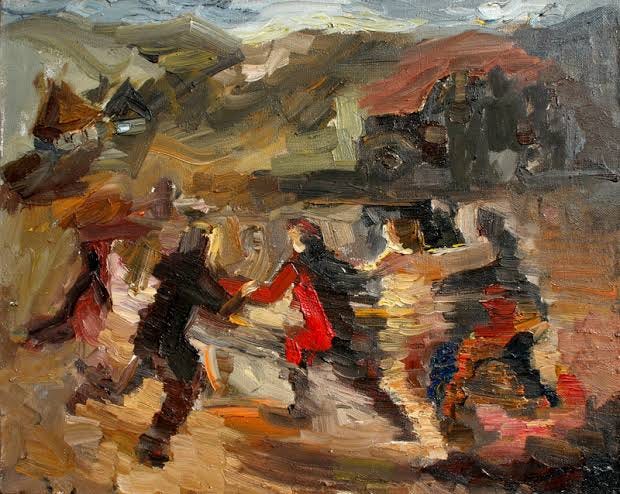
from here, painter unknown
This gives voice to something I haven’t adequately been able to communicate: coaching has been the deepest form of meditation I’ve experienced, through the lens of connection to someone else. I wasn’t aware this experience was available until I started, and it has given me a deeper love and respect for humanity. Thank you for a layered and gratifying piece of writing.
An enthralling read, thank you.