Act I
“I find it very difficult to find receptive clients in the times we are living. I feel anxiety in my body and I’m not sure what to do with it.” I am looking at him on Zoom, at the end of a webinar. Serious people, serious topics and after 90 minutes he punctures the seriousness, shyly, tentatively, with his honesty.
Maybe you would expect me to say, dear reader, that something cracked open and the room rushed towards him but it didn’t. The room stayed serious and I thought how hard it is to say "this is how this lands in me" and to follow that call. First time on camera there, seduced by the coolness and braininess, by the beauty of looking at a world on fire and making it make sense without attending to how it feels to inhabit it. "If I speak - I wonder - shouldn’t it also be brainy? Shouldn’t it somehow be about me?" There is something of the Kit Kat Club, that strange container from Cabaret, people dancing while outside reality sharpens its knives. And it is necessary because thinking is resistance and we need the room where people understand the joke. Then I look at his face, the disappointment of not being met, the red cheeks, and I raise my hand.
Three people later I tell him it is hard for me too, and that what helps is going towards their world even when it is foreign to mine, entangling with it even when it moves me elsewhere. Entangle with the other, the foreign, the repulsive. Entangle, don’t teach. And there is sadness there too: why can’t the world be like this cocoon? Why so bloody different out there? Can my anxiety live alongside this? I didn’t have time to say that part and perhaps that is why his eyes stayed with me.
Parts of my childhood were dark and I remember being drawn to Poe because his darkness had curiosity and tenderness in it. Darkness not only as fear, but as the alien other, fear, yes, but also the unknown. Can I see it without judgement? Can I enter correspondence with it? Can I befriend “the monster”, discover each other’s worlds? Can a strange collaboration emerge? Sometimes the monster is actually dangerous and a child in danger and an adult afraid for his livelihood are not facing the same thing, but bodies have strange memories.
Sometimes, dear reader, going back into the library to study how to defeat the monstrous, or building a meta-balcony from which to observe it, locks us into battle. We become knowledgeable about the "monster" and still have never broken bread with it.
That seven-year-old had no method. What helped me then, and still helps me now, was curiosity: going closer, discovering that “monster” from far away becomes more complicated at close range. And places with friends where fear can be spoken aloud. Perhaps that is what these little Kit Kat Clubs or webinars are for: places to return to after getting entangled with what is strange to us, where we can say: this is hard, I am frightened and I don’t quite know what I am doing.
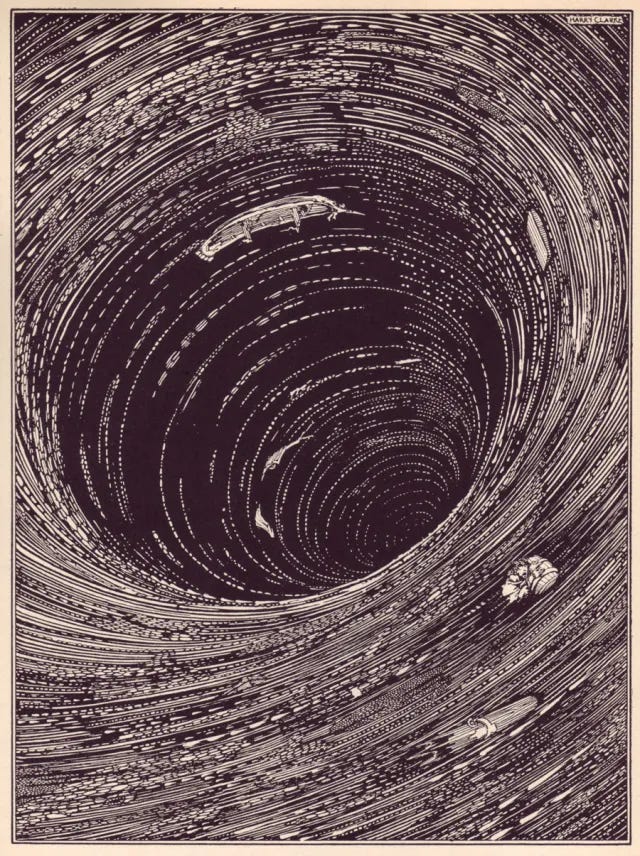
Harry Clarke, A Descent into the Maelstrom
Act II
I got influenced by Oliver Miskovic's comment on yesterday’s post to stay a bit longer with emotions and the power of those pesky things to re-orient what becomes possible in a room.
One moment on Zoom, one serious community, one man saying “I feel a lot of anxiety in my body and I’m not sure what to do with it”, and I keep wondering about the sliding doors and the multiple rooms that could have followed from that sentence.
In one room, somebody else gets curious and asks "what does the anxiety know? what are you encountering out there that the rest of us are not seeing?" Now his fear is not an unfortunate accompaniment to the conversation but information about the territory: clients retreating, work becoming harder to sell, a gap between what this community finds important and what the worlds we want to work with can receive. The anxiety has changed from noise to signal, and the room now knows something it didn’t know before.
In another room somebody says: "me too" and now his confession has a respondent. Another person risks being seen beside him, perhaps a third follows, and the thing that belonged to one anxious body becomes something held between bodies. Nothing about the market has changed, nobody has found him a client, and yet the room has. There is suddenly a little more “us” in it and a little more warmth and trust that we can hold eachother through difficult times.
In the room that actually happened, his anxiety enters the space, nobody rejects it, and the conversation carries on as if it never happened. Emotion has not vanished, his cheeks are still red, he is quieter. I am watching him while wondering whether I should just say something to him. Perhaps somebody else feels relief that we did not go into “feelings”. Perhaps another person wants to respond but the conversation has already established what belongs here. Nothing dramatic and yet the room is no longer the same room. The anxiety that could not become conversation begins instead to become orientation: who speaks, who doesn’t, what counts as relevant, how much vulnerability is safe next time, what kinds of knowledge this room can produce.
This is what we miss when we treat emotion as private weather happening inside individual bodies while the “real” system carries on. The same sentence could become information, could become relationship, or, marginalised, could become a constraint on what the room is capable of doing next. Same people, same Zoom call, same words, three rather different fields.
If fear changes the threshold for speaking, trust changes what can travel between people, and shame changes what can be risked, then emotion is not an extra layer laid over the system, it is already changing the pathways available to it. Ignore it if you like but it will not return the favour :)
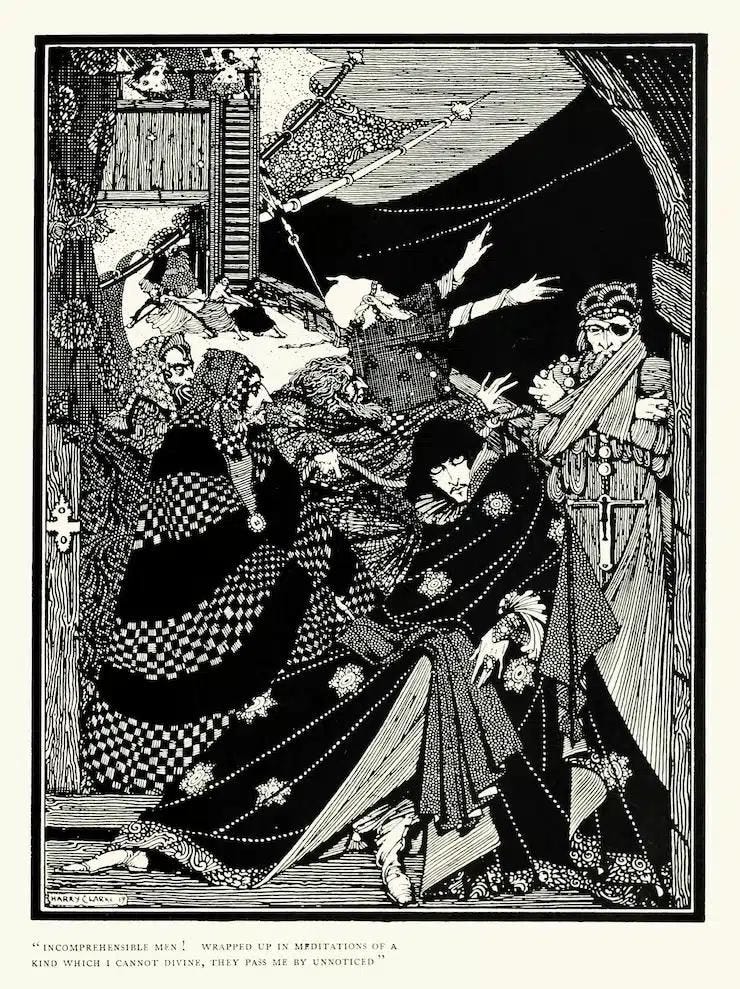
Picture: “Incomprehensible men! Wrapped up in meditations of a kind which I cannot divine, they pass me by unnoticed” Poe, MS. Found in a Bottle, illustrated by Harry Clarke.
Act III
I thought the topic of emotions in serious rooms was done after my second post on the matter, but then Nicola Robins brought the fascinating question of legitimacy into the comments of my last post and here we are, dear reader. Hopefully with her retrospective permission :) I re-imagined Nicola’s and my exchange through the lens of one of my favourite philosophers, Winnie-the-Pooh. Here you have it, with some meta-commentary and a little cross-pollination from Arnold Mindell.
Piglet: Sometimes someone says, “I hear your perspective,” and I know they haven’t really heard me.
Pooh: How do you know?
Piglet: I’m not sure. My stomach knows before I do.
Pooh: Is your stomach always right?
Piglet: Probably not.
Pooh: Then perhaps you shouldn’t listen to it.
(Piglet thinks about this.)
Piglet: But if I tell it to be quiet before I know what it is saying, how will I ever find out whether it was right?
(And there, I think, is something about legitimacy. Before anyone else tells us that our anger is too much, our unease irrational, our bodily “no” inappropriate, we may already have translated it into something better behaved: concern, risk, feedback. Quite Orwellian, if you think about it.)
Pooh: Does that make the feeling go away?
Piglet: No. I think it just stops using words.
Pooh: Where does it go then?
Piglet: Shoulders, jaws, silence. Sometimes into somebody else who suddenly gets angry for everyone.
(Pooh thinks about it.)
Pooh: That sounds inconvenient.
Piglet: Very.
(Perhaps this is where Mindell complicates the whole thing for me. What is marginalised in one channel has an irritating habit of appearing in another. The body is not an oracle: fear can be old fear, anger does not prove wrongdoing, disgust can carry prejudice. But if we deny the signal legitimacy before we have even encountered it, there is very little left to discern.)
Pooh: So what should we do with it?
Piglet: Maybe just let it finish its sentence before deciding whether we believe it.
(Perhaps legitimacy begins one moment earlier than we usually think: not when somebody else believes the signal, but when we allow it to become fully available to us. We can decide later what it means, but first perhaps we should let the pesky thing finish speaking.)
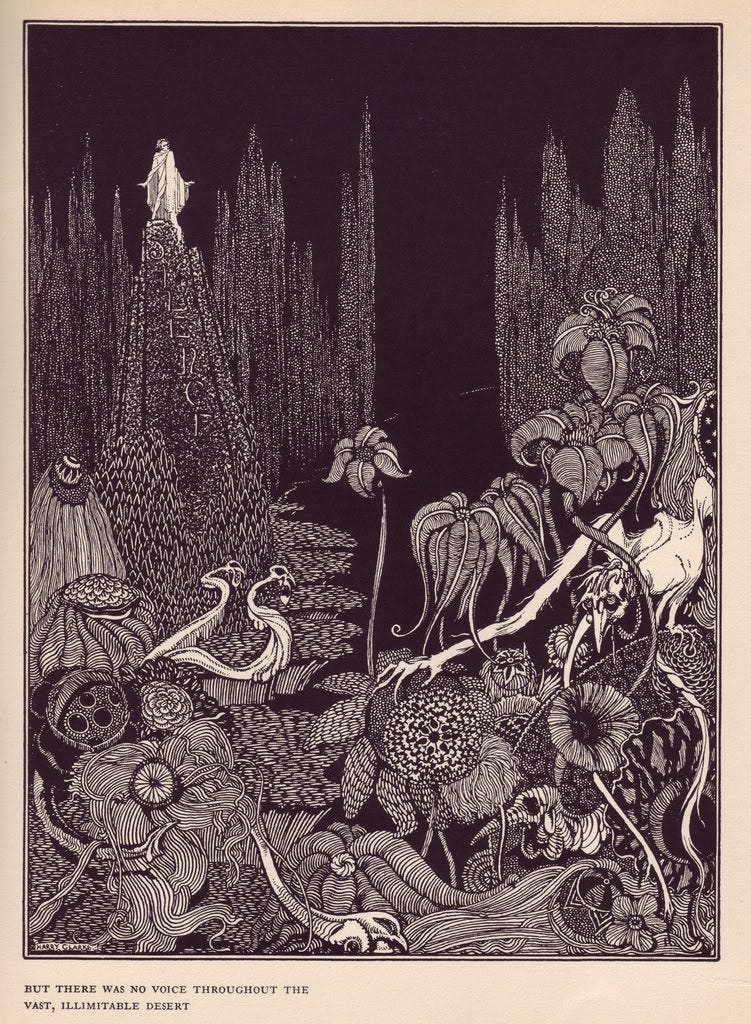
Harry Clarke, “Silence, a Fable”: “But there was no voice throughout the vast, illimitable desert.”